SILK Laser Eye Surgery — The Most Advanced Blade-Free, Flap-Free Vision Correction at a Trusted, NABH-Accredited Eye Care Hospital
Freedom from glasses and contact lenses — through SILK, the next generation of laser vision correction. Powered by the ELITA femtosecond platform. Personalised, precise, and performed across 5 eye care centres.
If you have been living with myopia, astigmatism, or the daily inconvenience of glasses and contact lenses, SILK laser eye surgery offers a transformative and permanent solution. SILK — Smooth Incision Lenticule Keratomileusis — is the most advanced form of corneal laser vision correction available today, blade-free, flap-free, and performed entirely within the intact cornea using a femtosecond laser.
What Is SILK Eye Surgery — And Why Is It the Next Generation of Laser Vision Correction?
A blade-free, flap-free procedure that reshapes the cornea from within.
SILK — Smooth Incision Lenticule Keratomileusis — is the most advanced corneal refractive surgery available today. It represents the latest evolution of laser vision correction, offering patients a blade-free, flap-free procedure that corrects myopia and astigmatism by reshaping the cornea from within, without the corneal flap required in LASIK eye surgery.
The procedure uses a femtosecond laser to create a precisely shaped disc of corneal tissue — called a lenticule — within the layers of the cornea. This lenticule is then extracted through a tiny incision of just 2–4mm, permanently changing the corneal curvature and correcting the refractive error. The result is clear, sharp vision, typically from the day after surgery, without the flap-related risks associated with conventional LASIK eye surgery.
According to the American Academy of Ophthalmology, flapless refractive surgery techniques represent a significant advance in corneal biomechanical preservation compared to flap-based procedures — making SILK particularly suitable for patients who were previously borderline candidates for LASIK eye surgery due to corneal thickness or lifestyle considerations.
At MediVision Eye Care Centre, SILK is part of our comprehensive eye care approach to vision correction — offered alongside LASIK eye surgery, PRK, and ICL to ensure every patient receives the most appropriate advanced eye treatment for their individual eyes.
How Is SILK Different From LASIK Eye Surgery — Which Is Right for You?
Both correct refractive errors, but they work differently — and the right choice depends on your eyes.
In LASIK eye surgery, a thin corneal flap (100–120 microns) is first created using either a microkeratome blade or a femtosecond laser, lifted, and then excimer laser reshaping is applied to the exposed stromal bed before the flap is repositioned. The flap never fully reintegrates — it heals by adhesion but remains a structural change in the cornea.
In SILK, there is no flap. The entire procedure is performed within the intact cornea using a single femtosecond laser, creating and extracting a lenticule through a tiny incision without ever lifting the anterior corneal surface — preserving the structural integrity of the anterior cornea far more completely than LASIK eye surgery.
What Are the Advantages of SILK Over LASIK Eye Surgery?
| Feature | SILK | LASIK Eye Surgery |
|---|---|---|
| Flap creation | No flap — entire procedure within intact cornea | Flap created (100–120 microns) |
| Incision size | 2–4mm small incision | Full flap circumference |
| Corneal nerve disruption | Minimal | More extensive |
| Post-operative dry eye | Lower risk | Higher risk |
| Corneal biomechanical strength | Greater preservation | Reduced — flap weakens anterior stroma |
| Suitability for active lifestyle | Excellent — no flap to displace | Caution in contact sports |
| Recovery | 24–48 hours to functional vision | 24–48 hours |
| Laser used | Femtosecond only | Femtosecond + Excimer |
| Prescription range | Myopia up to -12.00D, astigmatism up to -6.00D | Broader range including hyperopia |
Our eye specialist doctors assess every vision correction candidate individually — recommending SILK, LASIK eye surgery, PRK, or ICL based on corneal topography, prescription, tear film, and lifestyle. No single procedure is universally superior.
How Does SILK Eye Surgery Work — A Step-by-Step Guide
A precise, comfortable procedure taking less than 15 minutes, with most patients seeing clearly by the next morning.
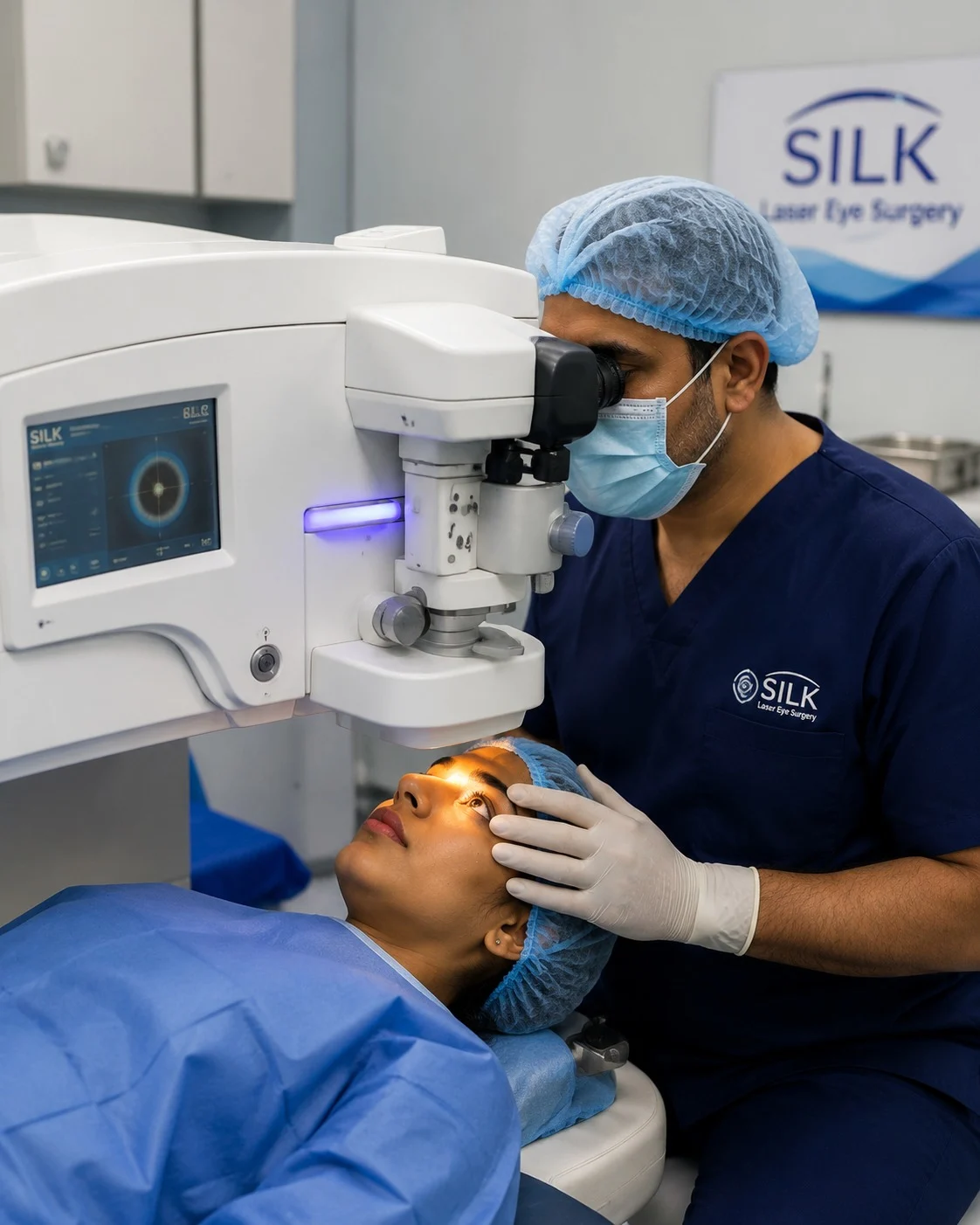
SILK is performed at our NABH-accredited eye care hospital as a day procedure — you arrive, undergo surgery, rest briefly, and return home the same day. The entire SILK procedure on both eyes takes less than 15 minutes.
Before the Procedure
Anaesthetic eye drops are instilled to completely numb the surface of the eye, ensuring a painless, comfortable experience throughout. No injections are required. Our eye specialist doctors confirm final measurements and the treatment plan immediately before the procedure begins.
During the Procedure
The ELITA femtosecond laser is precisely positioned over the eye. Two laser passes create the lenticule — a disc of corneal stromal tissue of predetermined size, shape, and thickness, calculated to correct your exact refractive error:
- First pass — creates the posterior surface of the lenticule within the corneal stroma
- Second pass — creates the anterior surface of the lenticule and the small side-cut incision
Our eye specialist doctor then manually separates the lenticule from the surrounding corneal tissue and removes it through the small incision. The cornea is immediately reshaped — the entire laser application takes approximately 25–30 seconds per eye.
After the Procedure
You rest comfortably for a short observation period. Most patients notice dramatically improved vision within hours of surgery and achieve functional vision by the following morning. Antibiotic and anti-inflammatory eye drops support healing, with follow-up appointments at 1 day, 1 week, and 1 month post-operatively. Most patients return to desk work within 24–48 hours; swimming and contact sports should be avoided for 4 weeks.
The ELITA Machine — Precision Technology Powering SILK at MediVision
SILK outcomes depend on the laser platform. ELITA sets the benchmark for precision in advanced laser vision correction.
At MediVision Eye Care Centre, SILK eye surgery is performed exclusively on the ELITA femtosecond laser platform — manufactured by Johnson & Johnson Vision, one of the world's leading ophthalmic technology companies.
What Makes ELITA the Right Choice for SILK?
Precision and Accuracy
A high-repetition-rate femtosecond laser with precise spot spacing and pulse energy control — creating a smooth, well-defined lenticule interface for easy extraction and consistent outcomes.
Real-Time OCT Guidance
Integrated optical coherence tomography imaging monitors corneal dimensions and lenticule position in real time — an additional safety layer even in challenging corneal geometries.
Customised Treatment Planning
Each procedure is individually calculated based on refractive error, corneal topography, and thickness measurements — tailored uniquely to your eyes.
Established Global Safety Record
ELITA is in use at leading refractive eye care hospitals worldwide, with clinical performance data supporting its safety, efficacy, and reproducibility.
Are You a Candidate for SILK Eye Surgery — What Does Our Eye Care Hospital Assess?
SILK is not suitable for everyone — a comprehensive pre-operative eye checkup is the only way to determine your eligibility accurately.
Before recommending SILK laser eye surgery, our eye specialist doctors perform a thorough pre-operative assessment to confirm that your eyes are suitable for this form of advanced eye treatment.
Basic Eligibility Criteria for SILK
- Age — at least 18 years old, with maximum benefit typically between 18 and 40
- Stable refractive error — prescription stable for at least 6 months prior to surgery
- Prescription range — myopia up to -12.00D, with or without astigmatism up to -6.00D
- Adequate corneal thickness — measured by pachymetry at your pre-operative checkup
- Healthy cornea — keratoconus or irregular topography are contraindications
- No active ocular surface disease — significant dry eye must be addressed first
- No previous corneal or intraocular surgery — requires specialist assessment
- Not pregnant or breastfeeding — deferred until 3 months after, once prescription is stable
Our eye specialist doctors will recommend the most appropriate alternative — LASIK eye surgery, PRK, or ICL — based on your individual corneal profile. Every patient receives an honest, personalised recommendation, not a one-size-fits-all procedure.
Book a comprehensive eye checkup to find out if SILK is right for you.
Check My EligibilityWhat Are the Benefits of SILK Laser Vision Correction?
SILK delivers advanced eye treatment outcomes that go beyond simply removing glasses — it transforms daily life.
Freedom From Glasses and Contacts
The most life-changing benefit — waking up with clear vision, driving, swimming, and pursuing sports without optical aids. Most patients achieve 6/6 vision or better.
Blade-Free, Flap-Free Safety
Eliminates flap-related complications associated with LASIK — no flap to displace during contact sport, trauma, or eye rubbing after the procedure.
Reduced Post-Operative Dry Eye
Preserves the anterior corneal surface and disrupts fewer corneal nerves than LASIK, significantly reducing dry eye symptoms.
Greater Biomechanical Stability
The strongest structural layer of the cornea — the anterior stroma — is preserved entirely, in contrast to LASIK, where flap creation weakens this layer.
Rapid Recovery, Minimal Downtime
Most patients achieve functional vision within 24 hours and return to work within 1–2 days, with minimal foreign body sensation.
Precise, Personalised Correction
Every procedure is individually calculated on the ELITA platform, incorporating your exact corneal measurements and topography data.
Long-Term Stable Results
For patients meeting candidacy criteria, SILK delivers long-term stable outcomes — corneal reshaping is permanent, lasting for decades.
SILK vs Other Vision Correction Options — Which Procedure Is Right for Your Eyes?
Four procedures. One goal: the clearest, safest path to spectacle freedom for your eyes.
| Feature | SILK | LASIK | PRK | ICL |
|---|---|---|---|---|
| Flap required | No | Yes | No | No (lens based) |
| Corneal tissue removed | Yes (lenticule) | Yes (ablation) | Yes (surface) | No |
| Natural lens preserved | Yes | Yes | Yes | Yes |
| Laser type | Femtosecond only | Femto + Excimer | Excimer only | None |
| Myopia range | Up to -12.00D | Up to -10.00D | Up to -8.00D | Up to -20.00D |
| Hyperopia correction | No | Yes | Yes | Yes |
| Post-op dry eye risk | Low | Moderate | Low | Low |
| Recovery | 24–48 hours | 24–48 hours | 1–2 weeks | 24 hours |
| Biomechanical preservation | High | Moderate | High | N/A |
| Reversible | No | No | No | Yes |
Our eye specialist doctors recommend the procedure most suited to your individual eyes — based on a complete pre-operative comprehensive eye checkup.
Why Is Early Vision Correction Through SILK the Right Investment in Your Eye Health?
Every year in glasses or contact lenses is a year of unnecessary limitation.
Eliminates Contact Lens Risks
Contact lens wearers face a lifelong risk of microbial keratitis — a leading cause of preventable corneal scarring. SILK removes this ongoing risk entirely.
Improves Confidence
Freedom from glasses and contacts consistently translates into improved professional confidence, social interaction, and overall quality of life.
Protects Against Dry Eye Progression
Prolonged contact lens wear is a recognised cause of dry eye and corneal surface changes. SILK removes the contact lens from the equation entirely.
Enables Sport, Travel & Life
Swimming, diving, martial arts, and travel are all significantly easier without daily management of glasses or contact lenses.
Comprehensive Eye Care Continues
SILK does not end your relationship with our eye care hospital — regular checkups continue for glaucoma, retina, and cataract monitoring as you age.
What Else Supports SILK's Precision at MediVision?
Beyond the ELITA platform itself, a complete diagnostic workup underpins every SILK outcome.
Corneal Topography & Tomography
PentacamComprehensive 3D corneal mapping performed at every pre-operative checkup — screening for keratoconus, calculating residual stromal bed thickness, and optimising lenticule design.
Wavefront Aberrometry
Measures higher-order optical aberrations to guide treatment planning — enabling correction of finer optical imperfections that affect contrast sensitivity and night vision.
Tear Film Assessment
Complete tear film evaluation — tear break-up time, Schirmer's test, and meibomian gland assessment — performed at the pre-operative eye checkup. Patients requiring dry eye treatment are managed before SILK is scheduled.
Your SILK Eye Surgery Journey at MediVision — Step by Step
From your first call to lifelong follow-up — every step is supported.
Book a Free SILK Consultation
Call, WhatsApp, or book online. Our team schedules your comprehensive pre-operative eye checkup at the earliest slot. No referral required.
Comprehensive Pre-Operative Eye Checkup
Full candidacy assessment — visual acuity, refraction, corneal topography, pachymetry, tear film assessment, dilated fundus examination, and IOP measurement.
Procedure Recommendation & Counselling
Your eye specialist confirms SILK candidacy, presents the expected outcome, discusses realistic limitations, and answers all questions. No pressure, no rushed decisions.
SILK Surgery (Day Procedure)
The ELITA laser is programmed with your individualised parameters. The procedure is completed in under 15 minutes for both eyes — return home the same day.
Post-Operative Care & Recovery
Follow-up at 1 day, 1 week, and 1 month. Most patients achieve functional vision by the morning after surgery. Eye drops prescribed for 1–2 weeks.
Long-Term Comprehensive Eye Care
Annual checkups monitor long-term refractive stability, screen for glaucoma, assess retina health, and plan cataract treatment as you age.
Why Should You Choose MediVision Eye Care Hospital for SILK Eye Surgery?
NABH-Accredited for SILK
Pre-operative standards, laser calibration, surgical safety, anaesthesia management, and post-operative care all independently certified across all 4 centres.
Performed on the ELITA Platform
One of the most advanced and clinically validated femtosecond laser systems for SILK worldwide, matched by trained, experienced surgical expertise.
The Most Thorough Pre-Operative Assessment
Topography, pachymetry, tear film, wavefront aberrometry, and dilated fundus evaluation — screening rigorously for contraindications. We never prioritise volume over safety.
Offers Alternatives If SILK Isn't Suitable
LASIK, PRK, and ICL are all available, with the most appropriate procedure recommended based on your individual assessment — not the promotion of any single procedure.
Affordable & Transparently Priced
Pricing communicated clearly before any decision, with no hidden costs. Advanced eye treatment should be accessible without financial ambiguity.
Clear Vision Without Glasses — SILK Makes It Possible.
SILK represents the most advanced laser vision correction available today — blade-free, flap-free, precise, and personalised. Whether you're a long-time glasses wearer or someone told you weren't suitable for LASIK, SILK on the ELITA platform may be the advanced eye treatment your eyes have been waiting for.