

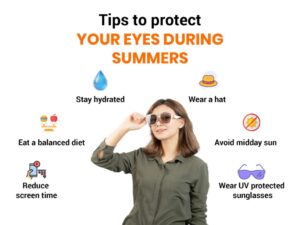
Hyderabad summers are hard on your eyes, and Kukatpally feels it more than most. Temperatures cross 42°C through April, May, and June. Add construction dust along JNTU Road, vehicle pollution on the Inner Ring Road, and long hours in dry air-conditioned offices, and your eyes take a beating from every direction at once.
Most people reach for sunscreen and cold water. Very few think about their eyes, one of the most exposed and vulnerable parts of the body in summer. The damage from UV rays, dry heat, and dust builds up quietly. You may not feel it today, but ignored summer eye stress can lead to dry eye syndrome, painful UV burns, worsening allergies, and even long-term cataract risk.
Children, senior citizens, two-wheeler commuters, and people who spend all day on screens are especially vulnerable. This guide covers what actually helps: how to protect your eyes from UV, the hydration and diet habits that matter, smart screen use, and the warning signs that mean it’s time to see an eye specialist in Kukatpally.
Why Summer Is Especially Hard on Your Eyes
The biggest threat is UV radiation, and it’s badly underestimated. Two types affect your eyes directly. UVA rays penetrate deep and contribute to cataracts and macular degeneration over years. UVB rays damage the corneal surface and can cause photokeratitis, essentially a sunburn on the eye that leaves it red, watery, and painful for a day or two.
In Hyderabad, the UV Index regularly crosses 8 in summer, which the World Health Organization classifies as “very high.” A common myth is that UV damage only happens on bright days. In reality, a large share of UV passes straight through light cloud cover, so overcast afternoons carry real risk too. Sun protection isn’t a clear-sky-only habit — it’s a daily one, from the first step outside your gate to the ride home after work.
Heat and dust add their own problems. Hot, dry air speeds up how fast your tears evaporate, leaving the eye surface exposed. Fine construction dust and pollution then settle on that already-dry surface, triggering irritation, redness, and allergic flare-ups. For anyone who commutes on two wheels through Kukatpally’s busy corridors, that combination hits every single day.
How to Protect Your Eyes From UV
Start with one simple habit: wear UV400-certified sunglasses every time you step outdoors, even for a five-minute walk to the kirana store or auto stand.
Not all sunglasses actually protect you. Look specifically for the UV400 label, which blocks both UVA and UVB rays completely. A dark tint without UV certification is worse than nothing, because it makes the pupil dilate while letting UV straight in. Cheap roadside sunglasses often fall into this trap — they look protective but aren’t.
A few more practical steps:
- Wear a wide-brimmed hat or cap for an extra layer during peak hours, roughly 10am to 4pm
- Use wrap-around goggles when riding through dusty stretches near JNTU Road, Balanagar, or the Inner Ring Road
- Protect children especially — their natural lenses are clearer and let more UV reach the retina, so kids genuinely need UV eyewear too
- Choose prescription sunglasses if you wear glasses, so you don’t have to trade clear vision for protection
- Don’t rely on the visor alone in your car; side windows let significant UV through
Building these into your routine now matters more than reacting later, because UV damage to the lens and retina is cumulative and largely irreversible once it’s done.
Hydration, Diet, and Screen Habits That Protect Your Eyes
UV protection is only one pillar. Three more make a measurable difference over the season.
Stay hydrated. Dehydration is a leading cause of summer dry eye. When your body is short on water, your tear glands can’t keep your eyes properly lubricated, leaving them dry, red, and itchy, and more prone to infection. Drink water consistently through the day rather than waiting until you feel thirsty, and remember that tea, coffee, and sugary drinks don’t count the same way plain water does.
Eat for your eyes. Certain nutrients actively protect the retina from UV and oxidative stress. Build these into everyday meals:
| Nutrient | Found in | Why it helps |
|---|---|---|
| Lutein & zeaxanthin | Spinach, methi | Filter harmful light, protect the retina |
| Vitamin C | Amla, guava | Antioxidant support for eye tissue |
| Vitamin A | Carrots | Supports the tear film and surface health |
| Omega-3 | Flaxseeds, fish | Improves tear quality, eases dryness |
None of these are exotic or expensive — they’re everyday items you can add to normal home meals, which makes them easy to keep up across the whole season.
Fix your screen habits. Most of Kukatpally’s working professionals spend eight or more hours a day on screens in cold, air-conditioned offices, and that dry air speeds up tear evaporation even further. Keep lubricating drops at your desk, blink consciously and often, match your screen brightness to the room, and position your monitor slightly below eye level so your eyelids cover more of the surface. Follow the 20-20-20 rule too: every 20 minutes, look 20 feet away for 20 seconds. For a deeper routine, see our guide to digital eye strain treatment in Kukatpally.
Common Summer Eye Problems in Kukatpally
Knowing what these conditions look like helps you act early rather than waiting until they worsen:
- Dry eye syndrome — grittiness, burning, and a tired feeling, worse in AC and by evening
- Allergic conjunctivitis — itching, redness, and watering, often triggered by dust and pollen
- Photokeratitis — painful, light-sensitive eyes after strong sun exposure without protection
- Styes and infections — more common when you rub dusty eyes with unwashed hands
- Worsening of existing conditions — early cataracts and retinal issues can progress faster with heavy UV exposure
Most of these are very treatable when caught early, which is exactly why the next section matters.
When to See an Eye Doctor This Summer
Home care handles most summer eye discomfort. But some symptoms need a professional, not an over-the-counter drop. Using random drops without a diagnosis can mask a problem and delay proper treatment.
See an eye doctor promptly if you have:
- Eye pain or a gritty, foreign-body feeling that doesn’t settle
- Persistent redness, watering, or swelling after dust exposure
- Any sudden change in vision, or blurring that doesn’t clear
- Light sensitivity severe enough to make it hard to keep your eyes open
- Discharge or crusting, which can signal conjunctivitis
An experienced eye specialist in Kukatpally can accurately diagnose dry eye syndrome, UV-related damage, allergic conjunctivitis, and early cataracts, all of which are more common in summer. Early treatment consistently means faster recovery, lower cost, and better protection for your vision. Don’t wait it out when your eyes are telling you something is wrong.
Protect Your Vision This Summer
Kukatpally residents face intense UV, dry heat, construction dust, screen fatigue, and air-conditioning all at once — one of the toughest combinations for eye health in any city. The habits above genuinely add up: certified sunglasses, steady hydration, eye-friendly food, and smarter screen use, backed by a checkup when something feels off.
Your eyes work every waking moment without rest, and a little consistency now protects them for years. If you’re dealing with dryness, irritation, or any discomfort that won’t settle, book an appointment with MediVision Kukatpally and get it looked at properly.
FAQs
How can I protect my eyes from heat in Kukatpally?
Wear UV400-certified sunglasses outdoors, stay well hydrated, use a hat during peak hours, and wear goggles in dusty areas.
Why is summer eye care important?
Heat, dust, and UV rays raise the risk of dry eye, irritation, UV burns, and infections, and some of the damage builds up silently over years.
When should I visit an eye hospital in Kukatpally?
If you have eye pain, persistent redness, discharge, light sensitivity, or any sudden change in vision, see a specialist promptly.
Do sunglasses really need to say UV400?
Yes. Only UV400 guarantees full UVA and UVB protection. A dark tint without UV certification can actually be worse than no sunglasses.
Can an eye doctor treat dry eyes caused by summer and AC?
Yes. An eye specialist can diagnose the cause and recommend suitable treatment, from lubricating drops to longer-term dry-eye management.
Are children more at risk from summer UV?
Yes. A child’s natural lens is clearer and lets more UV reach the retina, so UV-protective eyewear matters just as much for kids.

One Response