
Pediatric Eye Care — Expert Children's Eye Specialist at a Trusted, NABH-Accredited Eye Care Hospital
Comprehensive eye checkups, vision correction, amblyopia treatment, squint surgery, paediatric cataract care, and ROP screening — by experienced pediatric eye specialist doctors in a child-friendly environment across 5 centres.
A child's visual system is still developing — and the window for effective treatment of many childhood eye conditions is narrow. Children rarely complain about poor vision — they simply do not know what clear vision feels like. That is why regular eye checkups are essential for every child, even when no symptoms are obvious.
What Is Pediatric Eye Care — And Why Does Every Child Need a Specialist Eye Doctor?
The visual cortex develops until age 8–10 — and vision lost during that window may never be recovered.
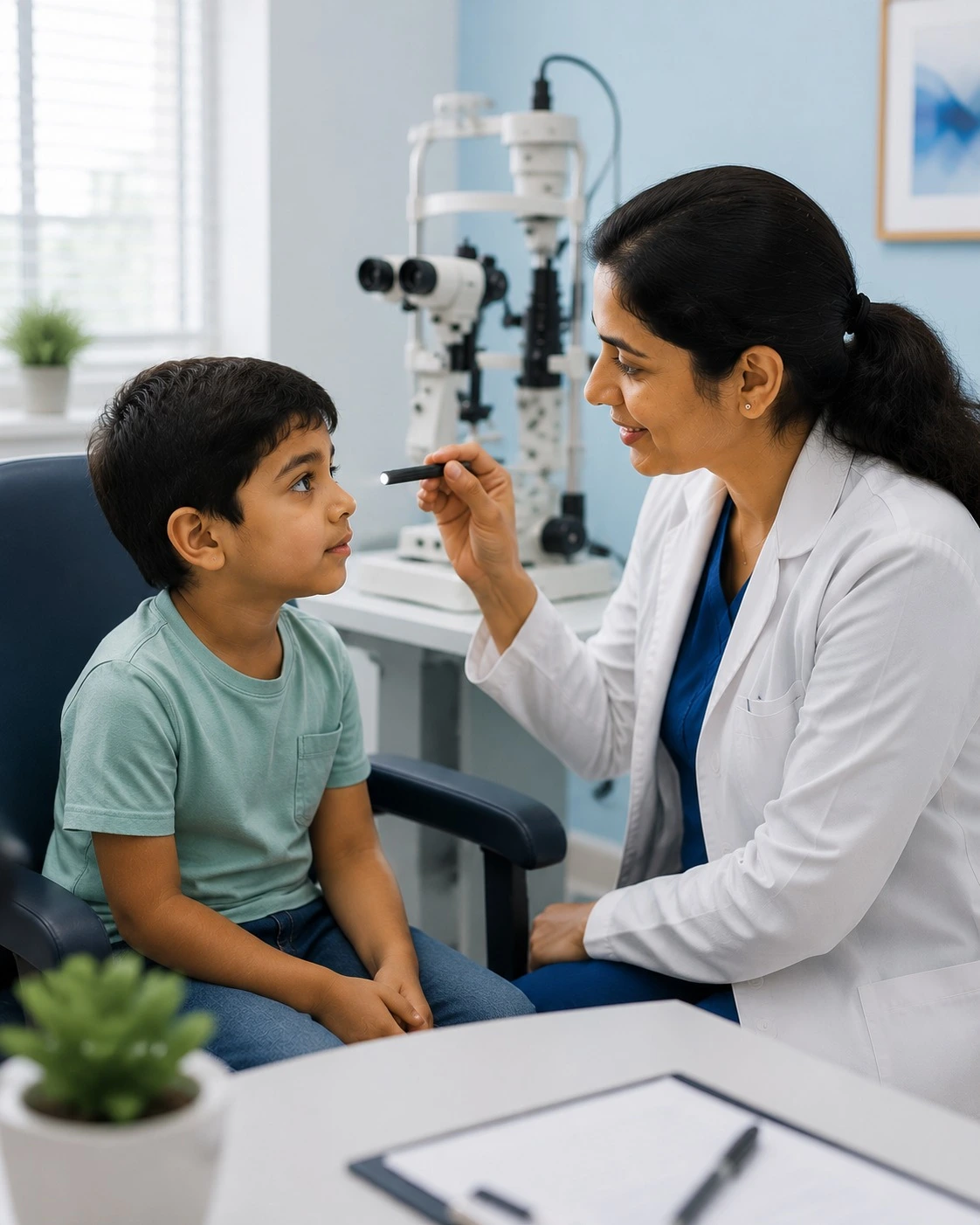
Pediatric eye care — formally known as paediatric ophthalmology — is the subspecialty of eye medicine dedicated entirely to the diagnosis, treatment, and prevention of eye and vision conditions in infants, children, and adolescents. A pediatric eye specialist doctor manages not just the eyes but the developing visual system.
Children's eyes are fundamentally different from adult eyes — not just in size, but in neurological plasticity. Conditions that deprive one or both eyes of clear, focused vision during the developmental window — including refractive errors, amblyopia, squint, and paediatric cataract — can cause permanent vision loss that cannot be reversed after the window closes.
According to the World Health Organization, approximately one-third of global blindness and visual impairment originates from conditions that begin in childhood — many of which are preventable or treatable with timely pediatric eye care. The American Academy of Ophthalmology recommends comprehensive eye examinations for all children before school entry and annually thereafter.
Key Milestones in a Child's Visual Development
| Age | Visual Development Milestone | Eye Care Action |
|---|---|---|
| Birth–3 months | Fixes and follows faces and objects | Screen for congenital cataract, ROP in premature babies |
| 6 months | Binocular vision developing | First formal eye checkup if any concerns |
| 1–2 years | Visual acuity rapidly improving | Check for squint and amblyopia |
| 3–4 years | Pre-school eye checkup recommended | Comprehensive examination including refraction |
| 5 years (school entry) | Critical — refractive errors affect learning | Full comprehensive eye checkup mandatory |
| 6–8 years | Amblyopia treatment window closing | Annual checkup — last effective treatment period |
| 8–18 years | Myopia progression period | Annual vision correction review |
What Are the Warning Signs That Your Child May Have an Eye Problem?
Children cannot articulate vision problems — watch for these behavioural signs.
Because young children cannot describe or even recognise that their vision is abnormal, parents and teachers play a critical role in identifying warning signs. Watch for the following, and book a comprehensive eye checkup without delay if any are noticed:
- Watching the board or books from very close distance — a classic sign of myopia
- Frequent eye rubbing — can indicate refractive error, allergy, or fatigue
- Watering eyes while reading — may indicate refractive error or lacrimal problems
- Squeezing eyes to see — a pinhole effect that temporarily sharpens blurred vision
- Squinting or closing one eye — can indicate refractive error, amblyopia, or squint
- An abnormal head tilt or turn — a compensatory posture for squint or unequal refraction
- Difficulty copying from the board — a common early sign of myopia in school-age children
- Slow reading and writing — often mistaken for learning difficulties
- A turned or misaligned eye — requires urgent assessment
- White reflex in the pupil in photographs — assess urgently, may indicate cataract or retinoblastoma
If your child shows any of these signs, do not wait for the next school health check.
Book a Checkup TodayRefractive Errors in Children — Myopia, Hyperopia & Astigmatism
Among the most impactful conditions on learning and development when left untreated.
Refractive errors are the most prevalent eye conditions in children worldwide. Unlike adults, children often do not recognise that their vision is abnormal — making regular comprehensive eye checkups the primary detection method.
Myopia (Short-Sightedness)
The most common refractive error in school-age children and one of the fastest-growing childhood health concerns globally. The child moves closer to the board and may struggle academically without realising why.
Hyperopia (Long-Sightedness)
Close objects appear blurred; moderate to high hyperopia causes eye strain, headaches, and is a major risk factor for amblyopia and accommodative esotropia. Often missed at routine school screenings.
Astigmatism
Caused by irregular corneal or lens curvature — produces blurred or distorted vision at all distances. A significant cause of amblyopia if uncorrected.
How Are Refractive Errors Treated?
Correction requires cycloplegic refraction — a comprehensive eye examination after dilating drops that relax the eye's focusing mechanism, revealing the true refractive error. This is essential in children, whose active accommodation can mask significant hyperopia.
- Spectacles — the primary correction method for children of all ages
- Contact lenses — for older children and adolescents where appropriate
- Refractive surgery — not recommended for progressing prescriptions; discussed once stable in adulthood
Amblyopia — Early Diagnosis and Treatment of Lazy Eye in Children
The most common cause of preventable vision impairment in children — entirely treatable when caught early.
Amblyopia occurs when the brain, during the critical period of visual development, receives a persistently blurred, unfocused, or misaligned image from one eye — and learns to suppress that eye's input. According to the American Academy of Ophthalmology, amblyopia affects approximately 2–3% of children worldwide.
Refractive Amblyopia
The most common cause. Significant uncorrected refractive error — especially high hyperopia or a difference between the two eyes — prevents clear image formation during development.
Strabismic Amblyopia
A squint causes the brain to suppress the deviating eye's image to avoid double vision. Squint is both a cause and consequence of amblyopia, treated together.
Deprivation Amblyopia
The most severe form — caused by a physical obstruction such as paediatric cataract or ptosis. Requires urgent treatment before permanent amblyopia sets in.
How Is Amblyopia Treated?
- Step 1 — Correct the refractive error — accurate spectacles worn full-time, producing improvement over months alone
- Step 2 — Occlusion therapy (patching) — the better eye is patched to force the brain to use the amblyopic eye
- Step 3 — Monitor and adjust — consistent follow-up every 6–8 weeks to assess improvement and compliance
What Other Eye Conditions Does MediVision's Pediatric Eye Care Programme Treat?
From squint to premature-birth screening — the full spectrum of childhood eye disease under one roof.
Squint (Strabismus) in Children
A turned or misaligned eye is never something to "wait and see" about. Squint causes amblyopia through suppression — without treatment, the child permanently loses functional vision in the affected eye. Management combines spectacle correction, amblyopia patching, prism glasses, and — where non-surgical options have not achieved alignment — squint surgery under general anaesthesia. Our dedicated squint treatment page covers the full diagnostic and surgical pathway in detail.
Paediatric Cataract
A cataract in a child's eye is a vision emergency, not something managed conservatively as in adults — a dense cataract obstructing the visual axis during the developmental window causes deprivation amblyopia, the most severe and hardest-to-treat form of lazy eye. Treatment is staged: surgical removal under general anaesthesia, optical rehabilitation (contact lenses for infants; spectacles or IOL for older children), and intensive amblyopia patching afterward — as important as the surgery itself.
Retinopathy of Prematurity (ROP)
A potentially blinding condition affecting the incompletely developed retinas of premature and low-birth-weight babies. Screening is required for babies with birth weight below 1,500g, gestational age of 32 weeks or less, or an unstable clinical course.
- First examination scheduled at 4–6 weeks of chronological age
- Performed using indirect ophthalmoscopy by our retina care and pediatric eye care team
- Laser photocoagulation or intravitreal Anti-VEGF injections for threshold ROP
Paediatric Glaucoma
Congenital and juvenile glaucoma present differently from adult-onset disease. Congenital glaucoma in infants presents with enlarged, cloudy eyes and excessive tearing. Juvenile glaucoma resembles adult open-angle glaucoma but often requires more aggressive treatment given lifetime visual implications — managed in coordination with our glaucoma treatment specialists.
Why Does Early Pediatric Eye Care Change Your Child's Visual Future?
The developmental window closes. Early eye checkups protect vision that cannot be restored later.
Prevents Permanent Amblyopia
Amblyopia treated before age 7 responds dramatically better than treatment initiated later — the difference between normal vision and lifelong impairment.
Enables Academic Success
Uncorrected refractive errors are one of the most common and overlooked causes of poor school performance — a child labelled slow may simply need glasses.
Identifies Serious Conditions Early
Comprehensive checkups detect paediatric cataract, glaucoma, retinal disease, and in rare cases retinoblastoma — at stages where treatment is most effective.
Builds a Foundation for Lifelong Eye Health
Children who receive regular pediatric eye care develop habits of annual checkups that serve them throughout adulthood.
Supports Social & Emotional Development
Vision problems affect sport, play, social interaction, and self-confidence — timely care gives every child the full visual capability to thrive.
Recommended Pediatric Eye Checkup Schedule
| Age Group | Recommended Eye Checkup |
|---|---|
| Premature babies / low birth weight | ROP screening per neonatal protocol |
| 0–12 months | At-birth screen + check at 6 months if any concern |
| 3–4 years | First formal comprehensive eye examination |
| 5 years (school entry) | Mandatory comprehensive eye checkup |
| 6–8 years | Annual — critical amblyopia treatment window |
| 9–18 years | Annual — myopia progression monitoring |
| Family history of eye conditions | Earlier and more frequent as advised |
What Advanced Technology and Child-Friendly Care Does MediVision Use for Pediatric Eye Care?
Accurate diagnosis in children requires both the right technology and the right approach.
Cycloplegic Refraction
The gold standard for measuring refractive error in children — performed after cycloplegic drops reveal the true prescription, essential for detecting amblyogenic hyperopia.
Retinoscopy & Auto-Refraction
Objective techniques that do not require the child's cooperation, enabling accurate measurement even in preverbal children and infants.
Orthoptic Assessment
Comprehensive assessment of binocular vision, eye alignment, ocular motility, and stereopsis — directly guiding treatment decisions.
Paediatric OCT
High-resolution structural imaging for ROP monitoring, paediatric glaucoma surveillance, and retina care for premature infants, without patient cooperation.
Indirect Ophthalmoscopy for ROP
Wide-field indirect ophthalmoscopy visualises the entire retinal periphery — the standard of care for ROP screening in neonates and infants.
Child-Friendly Examination Environment
Age-appropriate visual acuity charts, engaging fixation targets, and an unhurried consultation approach that builds trust with young patients.
How Does Pediatric Eye Care Work at MediVision? Your Child's Step-by-Step Journey
From your first call to lifelong monitoring — every step is supported.
Book Your Child's Eye Checkup
Call, WhatsApp, or book online. Inform our team of your child's age and any concerns — we'll advise on any preparation needed, such as bringing a recent prescription.
Comprehensive Pediatric Eye Examination
Visual acuity assessment with age-appropriate charts, cycloplegic refraction, orthoptic evaluation, slit-lamp exam, and dilated fundus assessment — at your child's own pace.
Diagnosis & Personalised Treatment Plan
Your child's eye specialist explains the diagnosis, options, and expected timeline in plain language to both you and, where appropriate, your child.
Treatment Initiation
Spectacle prescription, amblyopia patching regimen, surgical planning for squint or cataract, ROP laser, or glaucoma management — with complete written instructions.
Regular Monitoring & Adjustment
Visual acuity checked at every follow-up, patching adjusted based on response, prescriptions updated as your child grows.
Long-Term Comprehensive Eye Care
As children grow into adolescents, myopia may progress and vision correction options including LASIK become relevant — all within the same trusted eye care hospital.
Why Should You Choose MediVision for Your Child's Pediatric Eye Care?
Experienced With Children of All Ages
From newborn ROP screening and congenital cataract surgery in infants, to amblyopia treatment, squint surgery, and paediatric glaucoma management.
NABH-Accredited for Paediatric Surgery
Paediatric cataract treatment, squint surgery, oculoplasty for congenital ptosis, and ROP laser all follow NABH anaesthesia safety standards.
Manages Complex Conditions Together
Congenital cataract and glaucoma, ROP and vitreoretinal complications, or ptosis and amblyopia — fully integrated within the same eye care hospital.
A Genuinely Child-Friendly Approach
Age-appropriate tests, friendly fixation targets, and an unhurried, gentle approach — most reluctant young patients become cooperative by the second visit.
Guidance on Myopia Control
Evidence-based counselling on outdoor time, reduced near work, and appropriate optical correction strategies to manage progression.
Your Child's Vision Is Developing Right Now — We Help Protect It.
Every year, children lose vision to conditions that could have been prevented — amblyopia missed past the treatment window, paediatric cataract causing permanent deprivation, ROP missed without screening. With experienced children's eye specialists and a dedicated child-friendly environment across 4 centres, MediVision is the eye care hospital your child can trust from birth through adulthood.